
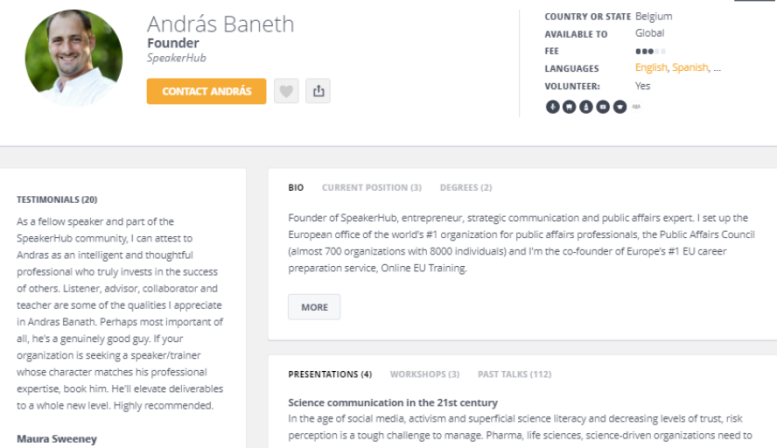
Andras Baneth:
Thank you so much for taking the time out of your business schedules to join this event.
Also thank you for submitting your profile, we've got quite a bit of interest there, and I’ve lined up many Speaker Hub profile pages in my browser, so I'll be sharing my screen with you in a second. But with that, I wanted to say that it's really courageous from everyone to put your name and your profile out there for everyone to review it and provide comments.
This should be a fun event. This should be a fun exercise where I give you my very best, and certainly honest, feedback and assessment of what I think could be better in a given profile.
I will also tell you what works fine so it's not all about constructive criticism, but certainly praise as well whenever I spot something which is helpful.
This should be a joint exercise, and that takes me to the second point where this is also peer-to-peer learning.
I am not claiming to be the first and foremost wise man on how a profile should look. I certainly have a unique perspective given that I created SpeakerHub and I've seen hundreds, if not thousands, of profiles. So I'll try to share those insights with you.
But if you see something and you think that it's worth sharing with others, or a certain point that others could benefit from and apply to their own profile, put that into the chat box and make sure that others hear your perspective because it's all about helping each other.
I love this American expression that “a rising tide raises all the boats”, which is exactly what we're trying to do here. Our aim is to help each other, the speaker community, to be more successful putting the word out there and have more opportunities to speak.
We're all about positive criticism. It's a review. It's all to make your profile stand out and be more successful to land more speaking gigs.
I'll get started with a broad comment saying whatever I say about one profile, I'll try to frame it in a way that's applicable to everyone else.
It's not just about making that person's profile page better, but it's about ideas, techniques, approaches that will be applicable to everyone else.
Hopefully, this will be helpful to everyone, not just to the person concerned or the person that we’ll be reviewing.
Let's see our very first profile. It's Greg Scott. So I've been in touch actually with Greg, we've exchanged a few emails. I am very grateful for his volunteering to have his profile reviewed, so this is the very first one.
My very first comment would be the header or the banner image where we can see his name.
And this is something you might hear me say in connection with other profiles as well, and it's: What is the number one idea, what is the number one priority you want to do with your speaker profile?
The number one thing is to establish yourself in the eyes of an event planner as an authoritative speaker. Someone who commands the stage. Someone that they can invite to their conference as a keynote or as a breakout session speaker, but someone who is a speaker.
This is a difficult challenge where you want to balance your pitch as an expert versus your pitch as a speaker. Certainly, you want to be an expert speaker of sorts.
The banner is a great opportunity to establish that authority as someone who commands the stage.
In this case, I would strongly suggest that Greg:
Uses an image where he's on the stage with an audience listening to him,
or in some contexts, he is in a broader situation, in a crowd that he commands, that he addresses
or he's behind a pulpit
or on a podium seen as presenting something.
If there's a slide behind him which shows his topic of expertise, even better.
That combines the speaking aspect and the subject matter expertise as a very first impression.
This in and by itself is insufficient, but it's still off paramount importance that we see the speaker as a speaker.
So this is a little bit of a missed opportunity to have this background where there's more that could be done. So that's perhaps the first idea.
Then we see a couple of other key points with country or state availability, fee, etc. I don't think there's anything major to comment on that.
The first point in this regard that I notice is there's no testimonial and no recommendation.

I would strongly encourage Greg to ask for testimonials from audiences or event planners he's spoken for.
If there are existing testimonials, just send us an email, we'll upload that into your profile.
We'll add that, so that should be done because it's really important to have third party validation: to have that sort of endorsement from others that you're not only claiming certain things, but others vouch for you.
The bio is interesting. It's a difficult one because you want to say stuff about your background, what you have done, what is your current situation, what are some of your achievements.
Yet, the bio is also already a sales pitch selling yourself as a speaker.
So it's a difficult writing exercise, which on the face of it seems simple, and that's why many speakers tend to miss it.
They just simply write a bio, and yet the bio has to be a mix between these two that I just mentioned, sales pitch or pitch of yourself as an expert speaker, and why you are presenting, what your professional background has been.
In this sense, I would suggest some rewriting.

I'll probably not go into any further detail there, other than to say to establish your authority — that you can address an audience on your topic of expertise because of your professional background having worked in digital, having worked with large enterprise systems for two or more decades.
The presentation title I find this one is a nice one.

Yet, it's really aimed at a very specific audience.
I don't think that non-IT experts would know what a “pen tester” is. I happen to know that because my brother is an ethical hacker: that's a penetration tester of how you can break into systems while, ethically, you're making sure that you are there before the bad guys.
But this is a good title, and as general advice for others, the presentation titles you want to put there should really be catchy and offer a true value proposition at the same time.
It should be catchy to the degree that a conference organizer could just copy and paste that into the event agenda and they say, "Okay, is this a title that I want to feature in my brochure coming up to the event?” Well, it's a pretty catchy title for that very specific audience.
Now if Greg wants to present to non-experts, or to a broader audience who are not into this very specific area of digital, I would propose to add a couple of other presentations as well, and make sure that the tiles speak to a broader audience too.
The past talks, I would encourage you to add more.
Why? — because this is really showing that you're an experienced presenter who goes out there a lot. One past talk would not give that impression, so try to add more, upload 5, 10, perhaps even more if you have that in your bag.
Then going further in terms of videos (something we'll come back to in a few moments with other profiles) is you probably want to do your first video on stage where you are really seen as a speaker who gives a keynote, or there is just a little trailer or a reel that you put together.
The first one here seems to have been recorded in a room, at least based on the thumbnail and that is not giving the best impression.
Whereas the third one on the right side, we can see him on stage, that's far better already as a speaker— and it adds that credibility.
Some of you may not know, we recently added a new field you can fill in, which is ‘clients’, so you can list the names of the clients you have worked for, or those who have hired you. Again, that adds an element of credibility and establishing yourself as a speaker.
Here the banner made me think for a second. Annalisa talks about intercultural issues as she's an intercultural strategist, which is a fascinating topic.

That is kind of reflected in the header, that there are a lot of major newspapers from around the world, there are headlines being featured.
Now, my first feeling was, "Well, these publications, have they featured her?" That's not the message here.
It reinforces our topic of expertise, but going back to my earlier point, I don't think this is the best way to present that in the header because it does speak to the topic she's an expert on, but it's not directly related to her, because it's not about her achievements, meaning having being featured in these publications.
I don't see the references to her as a speaker on these topics based on the header, and then there is this, the @ Twitter handle, @BecauseCulture.
That's nice, again, it references her topic of expertise, but then here again, it's a little bit of a missed opportunity or a lost opportunity when it comes to positioning herself as a speaker.
Let's go further. Let's look perhaps at the testimonials first.
In the testimonial, I see there is a nice one: "One of the most compelling speakers, her fresh take on cultural perspective."
All positive, well, obviously, you would probably not put any critical testimonial up there, but it's a good one.
Let me just address this topic of what sort of testimonials I would suggest you feature.
As a side note, you can re-order the testimonials that are used on your page, so that's why I'm saying you can choose which one to feature.

This is a good length:
it's not a one-liner,
not a two-liner,
it's a decent length: it's not too long. It’s something that someone browsing through her profile or when she applies directly and goes on her page would want to actually read.
That's very helpful. So the testimonial should certainly be positive, but there are different scales, or there's a scale of how positive it could or should be.
If it really talks about you in a little unrealistic terms, it might raise suspicion that "Okay, this is not that genuine."
This one, it's positive to the right degree.
Make sure that the testimonial you pick, or the one that you were given, it really kind of hits the mark but it doesn't go beyond that.
What I'm a little bit missing here is the position of this person offering the testimonial.
There's a name, and I could Google the name, but adding their position would really add a lot to the testimonial's weight, to its power.
So what position is this person in? Is it a reputable organization, or was this person the main organizer of a large conference, or what exactly is the context here? That would help a lot.

This one, the second testimonial, again, very positive, that's great.
I like the fact that somebody says, "Well, 5 out of 5."
It seems that there were some measurements behind it or perhaps just a person is very methodical and says, "If I were to rate this, here's the scale," that's good.
But there's no person behind it, so here's an educational team, that's good, and it's specific, so that makes it more credible. But then I would probably look for the person who gave this.
Let's go back to the bio.

Well, here's one question you might be asking yourself (and I don't have a strong view on this, it might really be your personal preference): Do you write the bio in the first-person singular or in the third-person?
There are probably different schools of thought: some speakers tend to prefer the third-person.
If I really were forced to take a position, I'd say first-person singular.
It's my page, I try to pitch myself, I try to position myself as a speaker.
So I would say, "Here is what I do, here's why I'm qualified to be hired as a speaker." This is really just a minor point.
Annalisa takes a different perspective from the one we saw with Greg.
It's not just describing what she's done in the past, but already positioning herself that she is a speaker on cultural differences and cultural elements, and how that relates to:
leadership,
marketing,
technology.
That's nice.
It says, "Keynote leading in a global village."

Yes, this is actually quite good. I would say though, a little too broad, a little too generic for my taste.
Again, with all the caveats that this might be fairly subjective, but to say, "Okay, why is this unique? Why does it stand out from other similar topics or others talking on this topic?"
Here I would encourage some brainstorming or copyrighting, like the one we saw in the previous profile. What would be a title that an event planner would want to insert into the brochure?
“Leading in a global village” is very topical. It's important, and yet it's a little dry. I would try to come up with something that's more eye-catching and compelling for a title.
"Data Science as a Social Science: Security and Privacy Across Cultural Borders."

My question here when I look at this is: “how does data science and social science come together? Is it really her key topic of expertise, given that she's a cross-cultural communication expert?”
As an event planner, I have a question, "Are you really the expert on this if your expertise falls in a different box?"
One of your key goals with the profile, with your speaker profile, is very similar to the way you write a resume.
Now many of you may have not written a resume for a very long time because you're freelancing and you are entrepreneurs.
Yet, the dynamics are very similar.
When you put your speaker page out there, the last thing you want is that an event planner has doubts or questions about the profile.
You don't want to make them wonder, make sure that they are really, really able to put you in the right box.
You might be very uncomfortable with this idea that "Hey, I don't fit in one single box."
Well that's fine, maybe you fit in two or three boxes, but event planners they want to see, "Okay, this is a motivational speaker, this is a cross-cultural speaker, this is a technology speaker or IT security speaker; this is a women empowerment speaker."
If you can have that consistent narrative in your profile, you probably have a winner.
If you speak on 2 or 3 very different topics, try to somehow give a reason or explain why you are qualified to speak on 2 or 3 different topics.
The minute an event planner starts wondering, they say, "Hm, well, how can somebody be an expert on 3 different topics? Maybe this person is not as trustworthy as I thought they were when I first spotted their profile. Maybe I'll skip."
Ultimately, it really is a “trust issue.”
That they trust your:
expertise,
your profile,
your speaking skills to the extent that they are willing to give you a try.
That is really the heart of it. So event planners are taking a big risk.
Especially if you have not spoken with their organization before, or if you have not been recommended by someone that they trust, and they're really just searching around on SpeakerHub and come across your profile.
They say to themselves,
"Can I trust this person not to embarrass me?”
“Can I trust this person to the degree that I will look good in the eyes of my boss and making sure that the audience will be happy?"
So everything you do, you want to not only minimize the doubt but increase the trust by every means possible, especially through your words.
That's my motivational part of it.
Let's look at the videos. Here I see 2 thumbnails which do not display.

Maybe the embed link or the link that they provided was not correct, or it had a typo, or just the system didn't pull it in for one reason or another.
It doesn't look so good.
So make sure that the thumbnail really shows and it shows an image that again, reinforces the pitch you want to sell.
If you are having trouble getting your video thumbnails to pull through, please contact us—we are here to help.
Sample slide number two, "Bias in Artificial Intelligence".

Again, I'm left wondering “how does that compare to the cross-cultural, intercultural aspect?”
It does, certainly, it does because there's a lot to do with how AI might be skewed against certain cultural patterns, there's a lot to say about that.
But again, somehow address it upfront.
AI and cross-cultural communication, connect that and make sure that in my eyes as the viewer, as the reader, as the organizer, this question is answered even before I can verbalize it.
You want to be proactive in addressing those questions, this way you create even more trust.
The banner is providing a pitch, "Tap the good, expanding minds and opportunities for successful futures."

Yes, but it's a little broad, it's a little too generic for me.
I would make it much more specific and again, the trade-off between topic versus speaker, it needs to be bridged.
Jacinta is a Toastmasters first place winner: this is powerful stuff.
Toastmasters is a great brand. Toastmasters is an organization well-known by almost everyone who's dealing with public speaking.
This is something to capitalize on because it reinforces her claim that she's a great speaker.
The fact that there's a speaking reel, that's good, and then the thumbnail where she's seen on stage passionately presenting about a topic.

Let me go a little bit further up and dissect the profile a bit.
Similar comment for the testimonials that I don't see the surname of the person. That's fine, there might be privacy issues at play.

But then what is the organization that this person represents?
It's written inside the testimonial but it would be nice to put that into the signature as well.
You might not know, but it is possible to do multiple bios for your profile.

Here's Bio 1, Bio 2 — it depends on where you are pitching yourself or which events are you pitching yourself for.
This way you can upload different bios and highlight different parts of your profile.
Now here, the bio two is empty so it might be a little glitch in her profile that she entered the field, so just make sure to clean that up and remove it if it doesn't have any specific information.
And then, let's go look further at presentations.
Here's the first one, so "Emotional intelligence healing from abuse to assault."

It's a keynote speech: where she uses her personal story; about her migration to the US, and then a relationship with a man who turned out to be physically, mentally and financially abusive. She speaks about how she ended up living on the street in California, and how she bounced back to pursue higher education.
This is very powerful.
And yet the description: it stops before it begins.
Here is what I mean— the description shows that there is a very, very powerful, difficult and important personal story that she shares, and yet, I say it stops because it's like starting a sentence but the other half of the sentence is how is that applicable to the audience?
How is that going to help the corporate audience and national conventions, a high school audience, what are they going to do with it?
This is something I see often when it comes to presentations and titles, where there's not enough emphasis on what does it give to the audience.
Why is it relevant, important, helpful to the audience?
So to say I'm an expert on _______ (fill in the blank). This is fine, but then here is what it's going to mean for you.
This can mean that your team is going to be three times more motivated after my speech to focus on this important issue than before.
Or emotional intelligence, it's just such a topical thing in the workplace today, and say, "Here is my personal story and here is how it ties into your business goals."
So this is, again, as a general comment, make sure that there's a very clear understanding from the organizer to say,
"Okay, this means you've been personally affected by some very difficult things in your life"
AND say,
"Okay, this is why you talk about this, but what does it give to me at the end of the day?"
They definitely, desperately, want to know where the match is between what you're selling and what I'm buying.
Here's another one which is actually better, much better from this perspective.
"Communication: Using the Art of Persuasion to Connect More Customers."

There's a pretty clear page saying, "I'll teach you how to be more persuasive so you can connect to more customers."
There's a description of
Learn 5 Psychologically Proven Art of Persuasion Tools You Can Use
10 Scientifically Proven Ways to be More Persuasive
Discover How to Turn Rebuttals Into Sales
This is absolutely better.
It's more specific because you talk about 5 specific things, 10 specific things, that I'm going to teach you.
This is more about, let's say it's in the grey-zone between a presentation and a workshop.
It can fly as both.
What I'm a little bit missing is that it's still relatively on the input side, so saying, "Here is my talk and it's well thought through, I have a very specific thing to share with you,"
But then again missing the part about what's the outcome, or what's the impact my talk is promising you.
You cannot guarantee that your sales teams afterward are going to triple their sales. Sure, you don't want to enter into legally difficult territory where you claim something that may not happen.
But you can say, "Well, as a result of the talk, this is what you can get out of it." Or, "Other clients who have hired me for the speech, this is what they reported."
That you can certainly claim because that's a given, those are our fact-driven claims.
Make sure that the corporate, the HR manager, or the corporate communications expert, or the secretary-general in that trade association that's organizing next week's convention or next year's convention, understands that:
"Okay, this seems like a good topic because our sales team is not so persuasive.
Fine, we have a pretty clear understanding of what the speaker would deliver.
Fine, how am I going to tell my boss that okay, we're going to pay her that amount of speaking fee and in the end what we can reasonably expect to get out of it?"
So make sure that those results, the outcomes, and the impact is clearly shown.
Chip actually put a nice image up there, so even with the screen in the back, Chip Morrison "Power Selling Seminars," I like that.

The image is a little small, so ideally try to format that in a way so that there is no black space or anything that may not look in the best possible way.
The picture is unique and that's great. He's
in a business suit,
with open arms,
with a very sort of approachable manner.
The testimonial. I see there are 73 testimonials, that's an impressive number and a lot of feedback from audiences. That's really good.

Here is something that you can certainly do on your presentation, where you tell the audience, "C
Popular Categories