
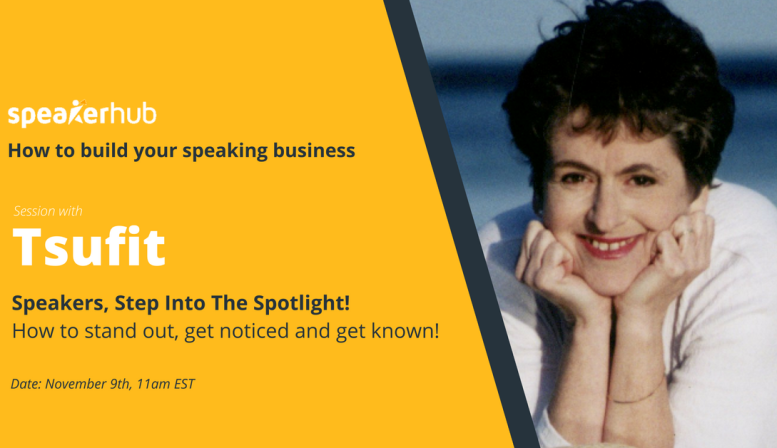
Tsufit: Hi everyone. My company specializes in the facilitation of soft scale solutions in a proactive environment. I’m the project manager. We’re a one stop shop for medium to mid sized businesses. Today our topic is….(laughs). I’m messing with you Andras. Don’t get upset. Don’t say “Why did I invite her?”
Andras: I knew that was coming.
Tsufit: Yes! Being boring is a huge mistake that speakers make. I don’t know how many of you believed me, but every time I speak live there’s a few people who believe that, and they’re shocked.
Being boring is a huge mistake, but that’s not what we’re going to discuss in this MasterClass today. Why? Because you already know that, right? Duh. Of course being boring is a big mistake. We’re going to go beyond that.
We’re going to talk about the business of being a speaker, and how you step into the spotlight, and get known, and get noticed. We’re going to do that in a very interesting way.
We’re not going to do it the way we usually do it with me telling you a bunch of stuff. I’m actually going to share with you the biggest mistakes speakers make. If we have enough time I’m going to share 12 of them.
Here’s what I want you to do. Pull out a piece of paper and a pen, or a pencil. Don’t try to do this on your computer, because it’s going to be way too hard on the computer. Put the paper horizontally, landscape, side to side. In the middle of the paper I want you to put a small little box about 2 inches by 2 inches square. In the middle of that box I want you to write speaker mistakes.
I want you to put some spokes coming out of that box in the middle, like the spokes on a bicycle. On the end of each spoke I want you to put a balloon or a bubble, a round circle. In each of those circles you’re going to fill in one of the mistakes.
Yes. I could have created a pretty PowerPoint for you, or asked Esther to create a pretty little PowerPoint for you, but I chose not to. Why? Because you will remember these mistakes way better if you write them in yourself.
I’ve got a ton to share with you, so let’s dive right in. Every time I share with you a mistake that prevents speakers from stepping into the spotlight i want you to write it in one of those circles or bubbles.
Mistake number one; jumping straight into the topic of the speech without telling your story. What I want you to write in the box is no story. That’s mistake number one; no story. Jumping straight into the teach and preach speech without telling your story.
I’m shocked by how many professional speakers do this. They start doing the teaching, and the preaching, and the audience is thinking “Who the heck are you? Why should I listen to you?” Before we dive into the whole big long list of the biggest mistakes speakers make that prevent them from stepping into the spotlight let me answer that question for you.
Andras shared a little bit about me in the introduction, but I’ll tell you a little bit more of my story. I’ve been on stage since I was a little kid. I was singing for the neighborhood kids on someone’s back deck, and I always wanted to be a star like on TV.
I grew up watching all the TV shows, and it was a much kinder, simpler time. Nobody ever voted you off the island, like they do on Survivor, it was a nice, gentle time.
I did get an amazing education. I graduated top of my class from the 19 inch institute of higher learning. Four p.m. sharp every day, a pretty rigorous program back then. In those days you actually had to get up off the couch and walk all the way over to the television, and turn the channels manually, I’m talking by hand, to get a full well rounded education at this institute.
Obviously I’m joking, one thing I learned from television. Now I make my living from what I learned from that TV box. Forget thinking outside the box. Why would you when everything you need to know is right in there in the box.
I learned so much from the TV shows, and especially from the commercials. Eventually I got some shows, some commercials, nothing fancy. It wasn’t a direct route to stardom. For 10 years I played the part of a lawyer, had four kids in four years.
20 years ago I made a monumental decision. I left the law, kept the kids, and decided to follow my dream and leave law for the limelight. I left business for show business. My parents were predictively thrilled. “You’re leaving law to be a what?” “Actress, schmactress,” is what my mom said.
But by being in both worlds, business and show business, I discovered that all business is show business. I’ve spent the past 14 years coaching speakers, experts, entrepreneurs, coaches, and professionals on how to get seen, heard, noticed, known, and how to step into the spotlight.
That’s me, that’s my story, a little quicker than I would normally tell it. Make sure you include your story in your speech so that it’s memorable enough for people to tell other people about you. That’s mistake number one; not including your story.
Mistake number two. I want you to write this in the second bubble. This one will surprise you, you’ll be shocked by this one probably. Identifying yourself primarily as a speaker. The big mistake that I want you to write in bubble number two is calling yourself a speaker.
What does that even mean, calling yourself a speaker? Everyone speaks, just like everyone walks, but you don’t see people walking around calling themselves walkers, or professional walkers.
The difference between a person in the spotlight, and everyone else, is that the person on stage has something important to say. Something unique to say about a particular topic, to a particular audience. It’s much smarter to get known as an expert who speaks, or an expert who trains people in his or her topic.
That doesn’t mean you have to have a PhD. You can be an expert from experience, because you studied it, because you researched it, like Napoleon Hill in Think and Grow Rich. Maybe you’re just a star in business like a Steve Jobs, a Mark Cuban, or a Seth Godin. But none of these guys identify themselves primarily as speakers, so that’s a big, big mistake.
Mistake number three is not knowing what to say when you only have 30 seconds in the spotlight. If you have 30 seconds, and you don’t know what to say in those 30 seconds, it’s not going to help you very much.
It’s funny, because I actually once a saw a speaker stand up and say that she was a humorous speaker on the topic of leadership, but her 30 seconds wasn’t humorous, so that didn't really get her very far. I heard her on a longer speech, and actually she was very funny. But that 30 seconds was boring, there was nothing funny about it.
You really have to figure out this 30 seconds. It’s different than a 30 minute or an hour speech. If you can’t say what you do in 30 seconds you will never be able to say it in 30 minutes either. Because the truth is guys you don’t even know the essence of what you do if you can’t say it in 30 seconds.
This is something you have to nail. It’s like a mini show, it’s a compressed period of time. That 30 seconds is so important I’ve even taught a four week course on the 30 seconds. It matters. In 30 seconds you’ve got to use story, color, flavor, drama, humor.
Silence (pauses), is also a great attention getter. Once I spoke at a networking event. When it was my turn to speak I started by being silent and sitting. Then in the middle of my 30 seconds I stood up, and it was a dramatic event.
If you get good at that 30 seconds it will be easier for you to get known as a speaker, and to attract speaking gigs. I’ve gotten a lot of speaking gigs just from my 30 seconds.
Don’t say your name at the beginning of your 30 seconds. Don’t say hi, I’m Jo Blow, and I’m a motivational speaker on the topic of leadership and self development, so go check out my website. You might as well stay home if you’re going to do that.
Nobody is going to check out your website unless you give them a compelling reason to go there. There are ways to get there, and I will demonstrate that to you in real time in a second.
I’ve got a hundred of these little, mini-30-second things. I call them infomercials, and I’ve written them over 14 years. But when I do a 30 seconds and say please go to my website it sounds needy, and being needy is a huge mistake.
You don’t need to sound needy. I don’t end it by saying, “So if you want to buy a copy of my book come see me afterwards, if you want to hire me to speak come…” I don’t do that.
I say, “20 bucks if I like you, 30 bucks if I don’t.” Everybody laughs in the room, and you know what they do when they approach me after the meeting? They approach me with their wallet in their hand, and they’re not sure if they should give me $20 or $30. They always ask me the same question, “Do you like me?” That’s one of the ways you can manage the 30 seconds.
If you want more on that, because I have a whole free tip series on how to master the 30 seconds, I’m going to give you a URL you can go to right now. Open a new browser. Go to that URL, spotlightsecrets.com. Put in your name and email.
A short second form will pop up, fill that in too. There’s a new law in Canada, and we need a higher level of permission. After that I will send you my 11 Free Spotlight Secrets on How to Nail Your 30 Seconds.
By the way, did you see how I got you to my website? That’s just one way of starting to build an audience. We’ll talk more about that later.
I want to tell you something. I once got a 15 minute spot on national television where my book was featured as a result of an impromptu 30 seconds with the host of the show just before she was getting ready to speak.
I was only in the audience. I wasn’t the speaker, she was the big speaker. But after meeting me for just 30 seconds she announced to the whole room that she was going to have me on her national TV show, and she did.
The same thing happened when I met Loral Langemeier from The Secret. We had a 30 second conversation, and she got me on her national radio show. It’s important to learn how to do this, and the free tips are at spotlightsecrets.com.
Mistake number four; being an interchangeable commodity with no persona, and no brand. It’s not enough to be a speaker. Do you want to be sent out when somebody says I need a speaker on leadership, I need a speaker on stress? No. You want them to say I want Tsufit. You want them to say get me Andras, because they’ve heard of you.
Remember in the olden days when you used to go to a CD store to buy a CD. You didn’t go there and flip through the thousands of CDs on the rack. You usually went in there with a specific CD in mind that you’re planning to buy, you bought it, and you walked out.
Do you want to be one of those thousands of CDs on the rack screaming to the customer, pick me, please pick me, pick me!. That’s what speakers do. Don’t do that.
You need a persona, you need a brand. What is a brand? You have to have a look, you have to have a language, you have to have phrases that you repeat over and over.
David Bach, a financial advisor, got on Opera by using the phrase, “The latte factor.” In Survivor they talk about “The tribe has spoken,” or things like that. It’s very important that you have a signature phrase you use.
Mistake number five; having a whole menu of speaking topics. Don’t do that. Why? You see a speaker’s website, they have a list of 17 topics; leadership, breaking the barriers, how to deal with stress at work...
Ideally you should have one main speaking topic. My main speaking topic is getting noticed, or stepping into the spotlight. People know that when they want to get noticed, when they want to step into the spotlight, that’s what I stand for.
I might have two or three other little mini speeches underneath that. I have one about the 30 seconds, or how to write a book, but they are all under the category of getting noticed.
Some of you might be thinking, if I only have one topic how will I ever get to speak to the same audience more than once? The answer is, you can dig down deeper, slice the onion even thinner. Your main speaking topic is your umbrella, but it’s okay to have a few sub topics.
Mistake number six is not understanding the concept of BYOF, which stands for bring your own fans. When I was a singer I thought it was enough to just be a great singer, the way some of you think it’s probably enough just to be a great speaker.
Once I was performing, I was singing at a little club, and the audience was kind of small. The owner came up to me and said, “Tsufit, bring your own fans.” I learned a lesson that day. She didn’t want me because I was a good singer, she wanted me because I was bringing people in the door.
When I spoke recently for an international coaching organization, a virtual chapter out of Los Angeles, they said it was the highest registration rate they’ve had in recent memory, and the highest turnout rate. That wasn’t just because of them, it was because I promoted it, and I brought some of my own fans.
Don’t always rely on the person who hired you to speak to fill the room. There’s two ways. These are not new mistakes, but these are sub under the mistake of not bringing your own fans.
How can you do that? There’s two things you’ve got to do. Number one, you’ve got to learn how to be your own publicist. Unless it’s a private, in house corporate function you need to publicize the event as well.
Andras publicized today, but I also sent out tweets about it, and LinkedIn updates, and all sorts of Facebook things about it because I want people to show up. I want this to be successful for Andras. I want him to be happy that people came. I want him to get fan mail from you guys afterwards saying you loved it, because it helps me, and it helps him.
You have to be your own publicist, number one. That will help you substantially increase your speaking fee. Because if they know when you show up people show up, your speaking fee will increase.
Number two, it’s very important to build a permission based email list. You can build online communities, I’ve got a Step Into the Spotlight group on LinkedIn, but the most important asset I have is a permission based email list. I already modeled to you how I built it when I invited you to go to www.spotlightsecrets.com and put your name and email in there.
What do I give in exchange for that? I give these three tips about how to stand out for 30 seconds. What do I get for that? I get people on my list who are interested in what I have to say.
If I released a new book tomorrow, which I’m not going to do, I would have a list of people to send that information to. If I’m speaking somewhere tomorrow I would have a list of people to send that information to.
Why is this so important for you to do next time you speak? Because it helps you step into the spotlight. Because when your speech is over guys all you’ve got is the audience you’ve built. Maybe a video or audio if you taped it, but basically all you’ve got is that audience.
The Beatles once said, “Let’s write ourselves a swimming pool.” What they meant is let’s write a song. They knew they had a big fan base, and they could get that song out to that hungry fan base. I don’t know how they did that without email, but now it’s a lot easier.
Without your own permission based email list you will always be chasing the next gig. People should chase you rather than you chase them.
Mistake number seven, requesting too low of a speaking fee. A member of my Step Into the Spotlight group on LinkedIn told us a story of how he lost a speaking gig, or maybe it was a training gig, because he asked for too low of a fee.
He almost had the deal, and he thought he was doing them a favor by lowering the fee. The guy in charge later told him that that’s why he lost it, because it undermined their confidence in him as a speaker. Do not make that mistake.
I have to assume that all you guys listening right now are great speakers, great at what you do, so don’t send mixed messages to people by offering to speak for peanuts. People are buying confidence, and your fee is part of how you communicate that confidence.
You wouldn’t expect to go to your local Walmart, or a local cheaper store you have in Europe, or in the Middle East, and find a Rolex for $20.
If somebody approaches me, and wants me to speak, and the fee is too low I tell them to save me for when they’re holding a bigger event with a bigger budget, or maybe when they can attract a sponsor. Often they will come back and do just that. So that’s mistake number seven.
Mistake number eight; not being narrow, or focused enough. Go narrow, or go home. What do you want to be? Do you want to be an EMT, a physician fixing broken arms and sore throats, or do you want to be a thoracic heart surgeon who gets paid much more? Which one is much more of a star? Who do you wait longer to see?
If you call yourself a speaker on leadership you might as well stay home and eat Twinkies. If your topic is stress management, stay home and watch TV. You need to slice that onion thinner and thinner until you own the topic, until people know what you stand for.
One of my clients is a lawyer. When I met him he had been in practice for over 30 years doing litigation, real estate, wills, and estate litigation. I told him, “Buddy, drop all that stuff. Drop the wills, the real estate, and only focus on one of these things.”
He ended up choosing estate litigation, but that’s still pretty broad, so we focused it even more. He now focuses on estate disputes between adult siblings, brothers and sisters. Because of that we’ve been able to almost double his fee, not quite but almost. His retainer is ten times what it was when we started, and he’s getting lots of media attention.
He’s being asked to speak. His colleagues are shaking their heads. They keep asking him, “How are you doing this?” Now he’s even working on a book on that topic, which by the way brings us to our next mistake.
Mistake number nine; not creating a book with your name on it. I know you guys have been told this before, and some of you are probably sick of hearing this, but books are natural marketing tools. Why? They crystallize your message in such a way that people consume it even if you’re not there.
Andras just shared with me that he’s in Belgium, and he’s partway through my book. I’ve never met Andras in person, there’s no reason he would ever have to read my book. If I didn’t have a book with my name on it he wouldn’t have probably heard of me in the first place.
If you use your book strategically, like fees, they increase your visibility, your credibility, your influence, your reach, and they are the perfect way to attract media attention to your speaking engagements. They’re also a perfect way to attract speaking engagements.
The late Dan Poynter used to say that “In the word authority is the word author.” When your book comes out send copies to the media, to bloggers, to influencers. To people like the leader of SpeakerHub, or people who have a platform for you.
If you’re smart your book title will be the same as your main speech title, and the same as your ten week course title, and the same as your LinkedIn group title, because that way you can bring yourself in the minds of your market. That’s really important too.
Mistake number ten is relying on speaking as your sole source of income. You don’t want speaking to be your sole source of income, because there’s only so much traveling a person can do, and there’s only so much schlepping around that a person can do before they get tired of it. Don’t you get tired of it?
I would suggest to you that your voice is going to give out at some point. You might be sick, you might not feel well. There’s a million reasons that you might want to have something on the back of your book, some kind of a business that’s on the back of your book.
A client of mine had a stroke and could no longer speak. Another one lost her voice. If that is your sole source of income, forget about it, you’re done. Speaking is best used as a part of your business, as a marketing tool, something big on the back end.
You can make your whole income from speaking, but if you have a few other things such as a program, an audio CD...While I’m speaking to you guys right now there’s somebody somewhere in the world who is taking my online course. There’s somebody else somewhere in the world who is listening to my CDs. There’s all sorts of stuff going on while I’m speaking to you.
I don’t have to rely on, if I show up today and my voice gives out. I don’t have to rely on speaking as my sole source of income. Doing so a big mistake, it’s best used as part of the whole thing.
Mistake number 11; going out of character. I want you guys to remember all business is show business. You cannot go out of character just because something technical goes wrong.
By the way, one of the best times to demonstrate to your audience that you’re not just another speaker is by how you react when there are technical glitches. Do you start whining? Do you say “My microphone is not working.” Or do you stay in control, and in command, and still stay a star in the eyes of your audience?
I don’t know if you guys over in Europe heard about Kanye West throwing down his microphone at a big concert in Toronto when his mic was acting up. I don’t know if that’s true, I wasn’t there, but I read about it online.
We’ve all seen performers and speakers complain when the mic’s not working, when the PowerPoint is not working. Well I went to a concert of a guy singer whose name is David Broza. The concert was in a huge auditorium, and the electricity went out. There were no lights, no amplification, and it was one of the best concerts I’ve ever seen. So mistake number 11 is going out of character.
I’ll give you one more example. I was singing at a nightclub, and I was really sick, I had a cold. My voice didn’t sound that great, but I couldn’t cancel because I was the whole show. Most singers would go up there and make excuses, like I don’t usually sound like this, or I’ve got a cold. No, I walked up, and took control, and made lemonade out of those lemons.
I walked in with a huge wicker bag, and I slowly and deliberately took out a box of Kleenex, and set it down on a stool. Then I took out a second box of Kleenex, and I set it on top of that. Then I took a third box of Kleenex, and I set it on top of the others. I did this until there were five boxes of Kleenex, a whole tower of Kleenex stacked on the stool.
Then I slowly and deliberately took out a jar of honey. Then I took out a box of cough drops. Then I took out a box of tea. I would have put a tea kettle in there if there had been room. With each thing that I pulled out slowly the audience started to laugh, and laugh, and laugh until I had them in the palm of my hand.
I have to say it wasn’t my best vocal performance, but it didn’t matter. Because as long as you’re in command you’re a star, and the audience loves you. So that’s mistake number 11.
Mistake number 12. I could go on for months with mistakes, but we’re going to wrap it up with mistake number 12; not knowing why you’re there. Every single time you speak you’ve got to ask yourself what is my goal today? Why am I schlepping around in my car? Why am I hopping on an airplane?
Beyond the applause. Beyond reaching out about something you’re passionate about you’ve got to ask yourself what narrow, specific results do I want to happen as a result of me speaking today.
Maybe you want them to buy your book. Maybe you want to be asked to speak at another conference, or a MasterClass like Andras has put on today for SpeakerHub. Maybe you want to add fans to your permission based email list like I suggested that you do by going to spotlight secrets.com. Maybe you want to be invited to appear on TV.
If you don’t know what your goal is, again, you might as well stay home and eat Twinkies. Lots of speakers make this mistake. I hope that you don’t.
In a second Andras is going to open it up for questions, but before we do that one thing. I want to give you one last chance to go to spotlightsecrets.com to get the free tips on How to Stand Out in 30 Seconds. Now I think we’re ready for questions Andras if you are.
Andras: Here’s the first one. What is your opinion about speaking for free?
Tsufit: If free means that there’s nothing in it for you, if free means no money, that they’re not paying you money at the beginning, if your model is as I suggested that it should be, that speaking is not your sole source of income...
There are people who speak for free all the time and make hundreds of thousands, if not millions of dollars on the back end. They’ve got courses to sell, they’ve got programs, they’ve got books, they’ve got one on one coaching, or mentoring. They’ve got other stuff. They’re used to speaking solely as a marketing function.
If that’s the case that’s okay. I don’t think that’s always the best idea because, like I said about the Rolex earlier, sometimes the fee telegraphs the value. If you’re ever asked to speak for free, let’s say they don’t have a budget, they don’t have any money, you have to ask yourself, okay, why am I doing this?
The money should never be the sole reason. Even if they pay you a zillion dollars, if the zillion dollars is the only reason you should still get at least one other thing out of it.
But let’s say they don’t have a budget, and they’re asking you to speak for free. Can you negotiate other stuff from them? Can you negotiate that they’ll arrange with their publicist to get you some media interviews, to spread recognition of you and build your brand? Can you negotiate that instead of being one of many speakers that they’re going to make you the keynote speaker of the event?
You may think that that’s not likely or probable, but I’ve actually done that before. I was asked to be a speaker at a conference, and they didn’t have my usual fee. I said, bump me up to a keynote and I’ll do it. I’ve done it because the recognition is useful. Usually when I’m a keynote they do pay the fee, but that could be one reason.
If it’s your ideal audience. If you can get in front of a thousand people, and if you have the back end as I suggested, or even hundreds of people that are ideal prospects for your other business, whatever business you’ve built on the back of your speaking, it may be worth it to you.
But it’s partially important to telegraph to your audience how valuable you are by charging a fee. It’s also important to telegraph to yourself how valuable you are. If you always speak for free you might undervalue yourself.
The other challenge that comes out of the question you asked is if you sometimes speak for free how do you navigate that. That is very, very challenging. Because if one guy is paying you $5,000 to speak for 45 minutes, and then another guy is not paying you anything, or giving you a small honorarium...And that’s a whole other big, long discussion.
There was a situation where someone was paying me a substantial amount to speak, and then another branch of the same organization that would have been more valuable to me in terms of who was in the audience, and future connections, and future speaking asked me to speak for free at a networking event.
If I hadn’t had that large paid one so close in proximity time wise I would have probably accepted the free one because it was good for me. I had to say no to that at that time, and I said save me for a future event, because it would have made the person who was paying me feel like an idiot.
Andras: Here’s a question about writing a book. What is your advice on writing it, getting it done, getting it promoted, and especially in light of self publishing?
Tsufit: Picked up and promoted seems to imply that whoever has asked this question is thinking of going with a publisher. That you’ll get Simon & Schuster to publish your book, and they’ll promote it. The truth is if you speak to enough authors, whether they’re self published, or published with a conventional publishing house, the promotion is really up to the author anyway.
Unless you’re one of the biggest names, unless you’re a celebrity, or known to be a really big draw, and you command huge audiences. The publishing houses only have so much money to allocate to publicity, and they’re not going to spend it on someone who is lesser known, or has a smaller audience.
In fact, Brendon Burchard, who has several successful New York Times bestselling books...One of the ways that he shared he was able to get a contract with a big publishing house was by putting in a speaker proposal that said something like I have an army of fans, or followers.
Remember when I sent you guys to spotlightspeakers.com? He built such a list by doing that, and on Facebook, and other social media, that when he went to a publisher it wasn’t so much about even reading the book. They knew if they published him people were going to buy it, whether it was a good or bad book.
There are a lot of books on the New York Times Bestseller list, not because they’re great books, but because people buy them. Why do people buy them? Because they’re a follower of this particular person.
That goes back to one of the mistakes I shared with you about not building a permission based email list, not building a following. That following is going to help you get a publisher to take you seriously.
I don’t think you should actively spend too much time and energy pursuing a publisher. I think with self publishing right now the books really don’t look any different, especially if you get them printed rather than digitally produced. Even so, they don’t really look that different.
You’re going to be promoting your book anyway, so you might as well have more control, you might as well own it. You might as well be able to control the cover. You might as well be able to control the back page where you give them a page where they can get more information about you, and bury some URLs in there so that you can build your list from readers of the book.
For whoever asked that question go ahead and self publish it. I do teach a book creation workshop if anyone wants to find out more about that, where we go over all the options, whether it’s self publishing, or publishing conventionally.
There’s some entrepreneurial publishi
Popular Categories