
One of the struggles many speakers face is how to get noticed and hired by more event planners. Having a complete, robust, and helpful profile on SpeakerHub will answer questions the event organizer might have, and help you put your best foot forward.
The live webinar clinic, “Make your profile stand out” is aimed to outline where you, as a speaker, can tweak and improve your profiles to attract more speaking engagements.
This recording of the webinar is for all speaker members.
As founder and CEO of SpeakerHub, András has the unique perspective of both being an experienced event organizer and speaker. He knows what event organizers are looking for, and has spent years perfecting the profile platform so that speakers are able to clearly talk about what they do in a way that helps organizers find the best speakers for their events.
Connect with Andras on your preferred platform
Thank you so much for joining me here today at this profile review webinar that so many of you have signed up for, and you are highly valued SpeakerHub members.
My name is Andras Baneth, I am the founder of SpeakerHub, and I'm running the service trying to be as helpful to you, as speakers, as possible, and trying to connect you with event planners.
This is really great that so many of you have shown up. We are recording this webinar so this will be available afterward. If there's anything you'd like to review, or any other information you'd like to take out of it, you'll be free to do that using the recording.
Some of you may be watching the recording in the first place, but those of you who are here at the live edition, you're very welcome to put in questions into the chat box if there is anything specific you'd like me to talk about in the context of the different profiles I'll be reviewing today.
Many of you have sent me links and asked me to take a look at your profiles, and I also have a couple of best practices or good examples I'd like to share with you.
A big caveat: Now despite being the founder and despite having seen hundreds if not thousands of profiles over the years, I am a person with some insights and views and opinions, but, of course, there could be other ways of making a speaker profile better to make it stand out.
I'll give you all my knowledge and insights on how to make your profile really great and get the attention of event planners, but, of course, ask your friends, ask peers, ask colleagues, ask anyone who can have a good opinion, a good review on your profile of how to make it better, how to make it look even greater to increase your chances of landing a speaking gig.
With that, let me try to share my screen, and I have a couple of links here that I'll pull up, and then we can get right into it.
Let's see, I'll try to share with you my browser window. I have a couple of speaker profiles of some of you who are actually here at this session, to be reviewed. And I'll give you my take on all of these and of what makes a profile stand out.
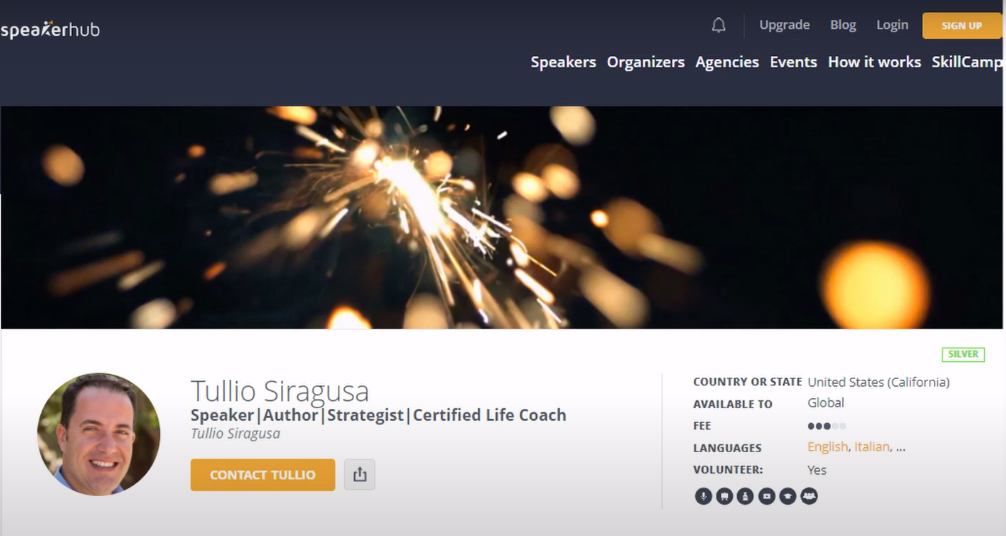
With this speaker, the very first thing that stands out, and that actually is true for many, many speakers whose profiles I've reviewed over the past few years, I'm talking mostly about the cover image, so that's the main image that you have on top of your speaker profile.
And that image for this particular person, it's Tullio Siragusa. Why don't I type his link into the chat box and then you can follow it even without screen share.
Here you go, this is Tullio's link, and you can pull up his profile on your end directly while the screen share is loading.
What I'm talking about right now is really the cover image and many, many speakers make the mistake where speakers do not really project the image of a speaker.
You can claim that you're a speaker, you can claim that you are a high profile presenter, but you want to showcase that to event planners; you want to make sure that the very first impression they get is,
"Oh my God, this person commands the stage. This person is really, really powerful in their message, on what they share on stage, and they are a speaker."
So you're not only declaring certain information, you're not only sharing that as a declaration on your end. It's something, it's a conclusion they come to.
And a great way of doing that is having a very, very powerful cover image where you are on stage and, hopefully, there's a large audience in front of you. And that really showcases you and puts you in that position.
In this particular case with Tullio's profile page, I don't see that. It's an abstract image or perhaps some sparklers or something like that, but it's not showcasing him as a speaker.
Going back to the profile, you can see the cover image that I talked about how important that is in positioning you as a speaker.
Now many of you are in the consulting business, many of you have books, many of you run workshops and trainings, I do that a lot as well — that's a slightly different image.
Being an expert on a topic is obviously really important because what you want to say to the audience needs to be very valuable.
But you want to distinguish yourself from other consultants who are doing consulting work from behind their computers and doing analytical work.
You are a speaker who commands the stage, and that is where there needs to be some overlap between having subject matter expertise and being a person who's great at public speaking, and you want to project that.
So let's go a little further and look at Tullio's other parts, the other components of his speaker page.
Let's look at the bio.
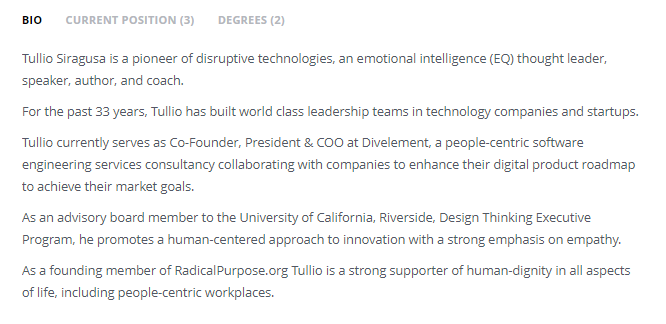
If you look at the bio, you see Tullio is a dynamic keynote speaker, author, host of Dojo LIVE! and the Rant & Grow podcast.
You see that he talks about some of his credentials, meaning he's a keynote speaker and he's an author and the very specific topic he talks about.
The bio is a tricky part of the profile. You already want to tell a story and pass a message in your bio, which is not really a resume, not your CV, for those who prefer that term.
The resume would be pretty much like this, a short pitch of who you are, but you already want to position yourself about what you deliver for event planners.
Think a little bit with the event planner's head — Okay, the person comes here and says, "Who is this person? Is this person safe to invite to my event? Are they going to provide enough value? Are they going to be a good speaker to engage my audience?"
And they say, "What is the value that I'm going to get out of that talk, that I might pay $1000, or $5000, or even more for that talk?"
The bio needs to establish credentials and they say, “This person has a certain number of years of experience, but how is that going to resonate with the need that I have?"
So to say this is the bio, here is the background, where he provides practical, actionable advice or actionable steps that your organization can double their revenue or triple employee retention.
It has to be very result-focused and it has to be very concrete. And that's another very common mistake that I've seen in a lot of profiles, that it tends to be too broad, especially when you talk about leadership, or talk about corporate culture, or resilience, or thriving in difficult situations.
These are great keywords but try to be more specific in what you deliver.
Especially topics like leadership. It's so broad, it's got so many aspects to it that you need to pick one element or one segment of the part you're going to talk about in a business context.
Let's go further and look at the presentations.
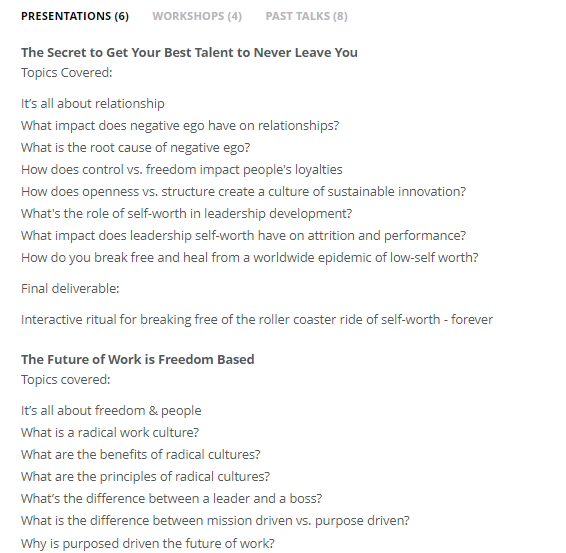
So presentations, where you can see the secret to get your best talent to never leave you. When I look at presentation titles, I often see two types of presentation descriptions and titles.
One that tries to sell the problem, and the other one really looks at solutions.
And this one is rather — yes there's a very strong case for selling the idea that yeah, talent leaving a company, that's a big problem, and he does mention the final deliverable, but it's not necessarily concrete enough, specific enough for a company to say,
"Okay, I understand you have highlighted a lot of issues we're facing, but how are you going to provide me those solutions in an hour or an hour and a half keynote, or a 45-minute keynote?"
So is your presentation selling the problem in the sense of raising awareness about a problem, even if it's unknown to you at this point? But then okay, what is that you can deliver to help my team right away?
And I talk about these terms mostly in a corporate setting, so most or many, many presentations obviously happen outside the corporate setting, but the vast majority would be companies, corporations, associations, business organizations, chambers, hiring speakers to talk to their staff.
There's certainly colleges and volunteer work and activist organizations who hire speakers as well, but we're focusing perhaps rather on the corporate and the business world.
So looking further, what else? If you look at left side testimonials: Excellent, so he has 9 testimonials, that's really good.
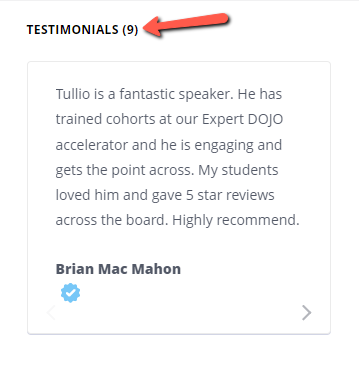
One thing I would point out is there is no job title next to the name of the person who gave the testimonial. Having just the name there, yeah, that's fine, it makes it more credible, but you probably want to put the organization's name there so that increases the credibility of testimonials and the endorsement.
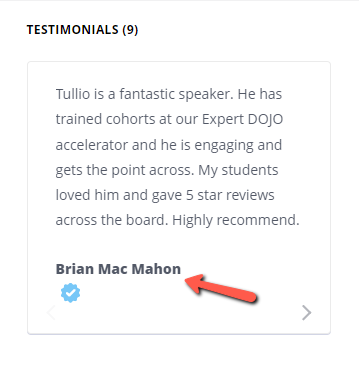
So again, that's another thing you might want to have on your own profile. Make sure that the person has indicated which organization they represent.
If you don't have that, send us an email and we can add that to the testimonials that are already on your profile. Just send us a mail and we'll take care of that.
Okay, now we are going to the next profile, and I have here Lois, and I hope I'm pronouncing your name properly, and I'll put into the chat box the link, okay.
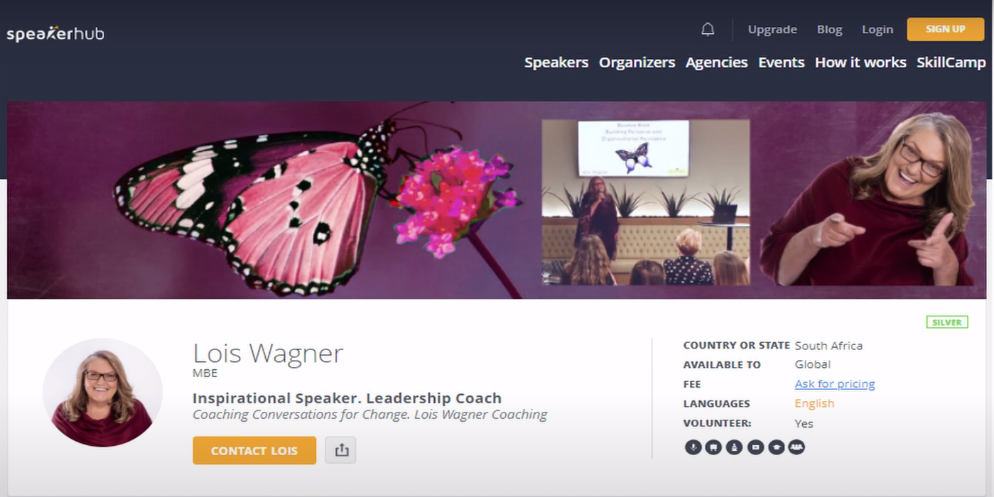
So here again, the cover image, okay it loaded, great.
The cover image is a very sweet and nice picture, but we would want to see her on stage or in front of an audience. So, wanting to showcase her as the speaker commanding the stage.
So we are further reviewing Lois's profile.
What else could be done better?
Again, looking at the bio, looking at the bio where it's a little short for my taste, talking about growth mindset, developing resilience, talks about forgiveness. Yes this is great, but this is not necessarily the bio part.
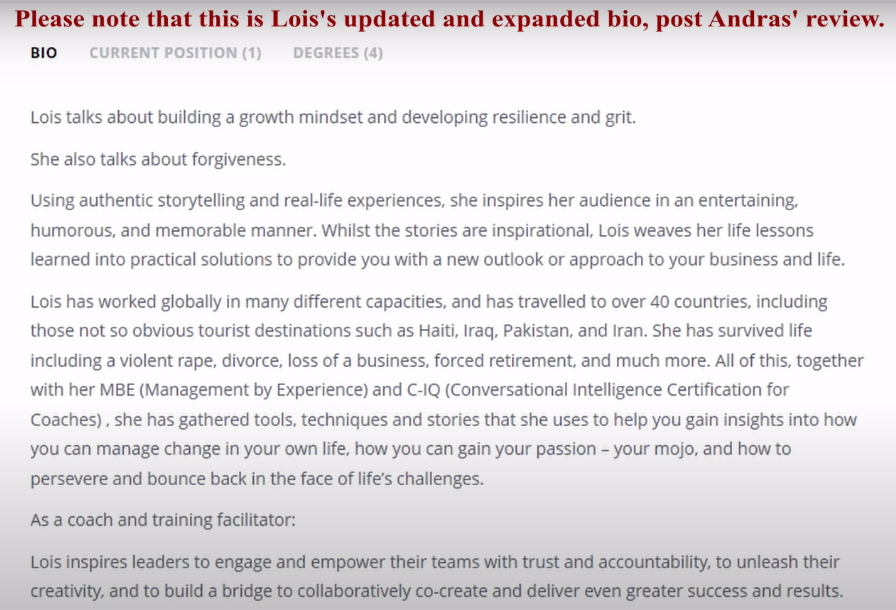
It could be woven into the bio so to say someone who's experienced and seen a lot, having traveled to 20 countries and having the craziest of experiences, sometimes with very difficult moments, has developed a resilience that she can share with you, so you and your team or the audience will come away with 3 ways to improve their lives the next day.
The bio, in some sense, is also a pitch.
The bio is also where you establish some credibility saying, "These are the specific things I've experienced, I've lived, or I've done in my professional background, and here is how it connects to the topic I talk about, which can help you in the following way."
This is a tricky sales message where you need to establish credibility by providing specific information about your background and your experience.
And then connect it to the talk that you will give.
And then sell that talk to the organizer so they will be persuaded in 2 sentences to say, "Okay, this is what I need."
And the rest of the profile is where you want to showcase self-declared credentials, meaning, "This is what I've done, this is how many companies or how many organizations I've spoken to, this is how many presentations I've given," meaning, I am a good speaker.
"This is how many countries I've visited," meaning, "I'm going to be fine if you invite me in the Middle East, or if you invite me in Latin America, in other cultural contexts I'll be fine as well."
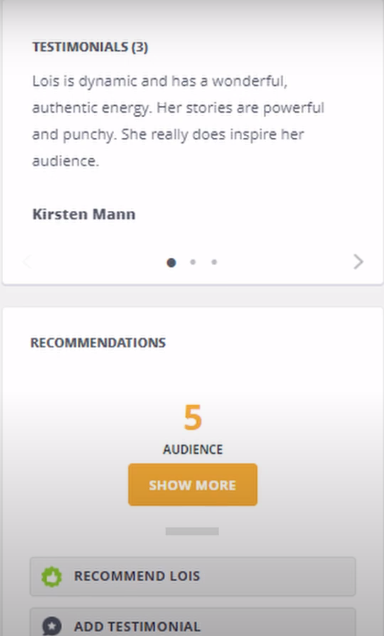
And then you want to add a third-party endorsement in the testimonials, recommendations, and you also want to showcase that you live up to your word, and that you do through the media part.
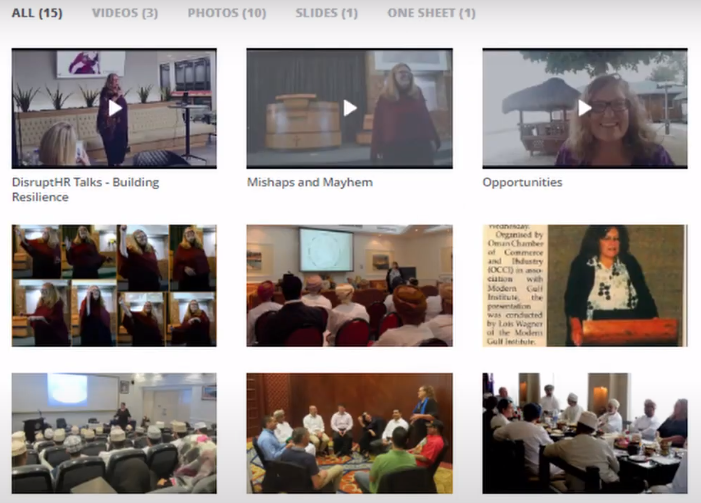
If you scroll down to the media part, where you have videos and other presentations, this is a really important part where you need to strategically think about what videos you put there, even what thumbnails you put there, so organizers may not even click the video itself but say, "Okay is this person on stage, is this person really a good public speaker and presenter?"
And then make sure that the expertise tags are filled in.
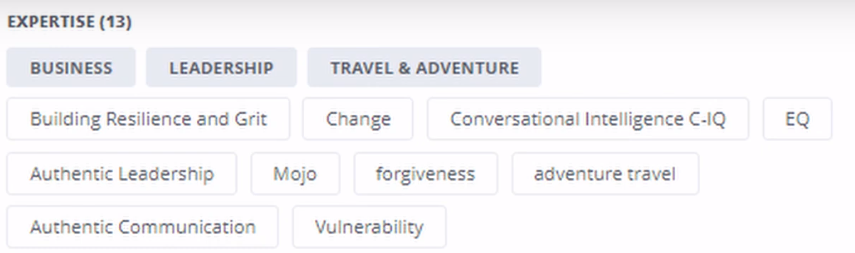
This actually serves a dual purpose. It's not only to show what topics you're an expert on so it's easier to find you based on keywords and tags, but it also matches you to events having the same tags and descriptors.
When we are matching you algorithmically to events that were placed like "Calls for speakers" on SpeakerHub, these expertise tags will play an important role in making sure that you get alerted about events that are of interest to you.
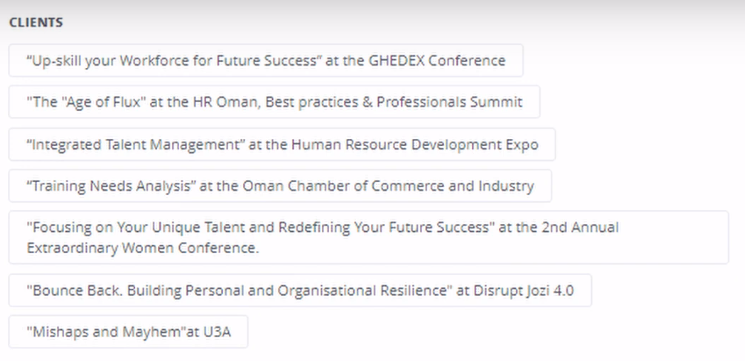
And then clients, if you scroll down to the client part, it's another very important part where you establish even more credibility saying,
“These companies, these organizations have trusted me, so I've spoken to their teams, I've spoken at their events," and the event planner can say, "Okay, if they trusted this speaker, I will trust this speaker as well."
All right, let's go to the next profile, which is going to be Paul. So, Paul, he might be here with us today, here's the link that I’ve pasted into the chatbox. So if you pull up the profile for Paul then you should be able to see his speaker page in a moment, as soon as the site loads.
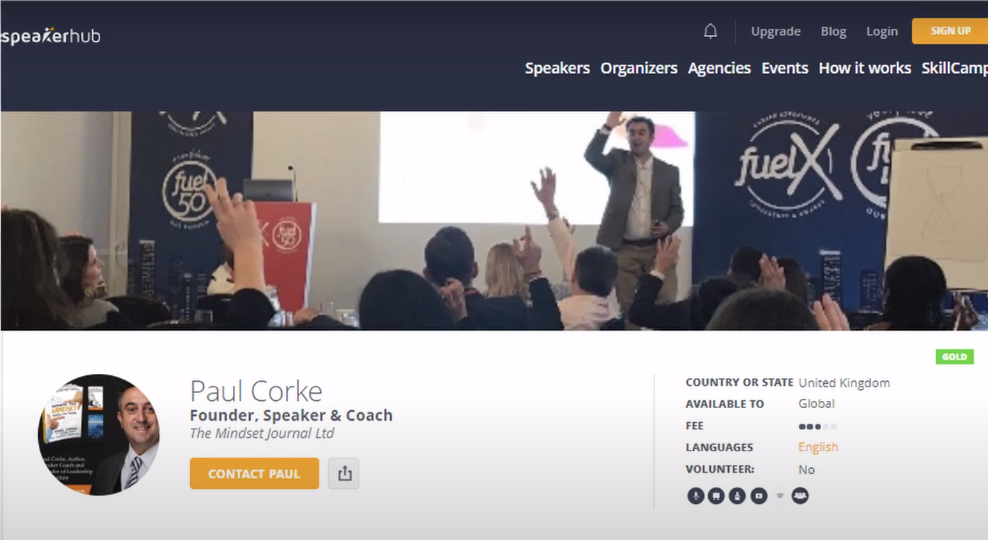
So, Paul, he’s actually put a pretty nice cover image where he's on stage and talking about, well, giving a presentation.
In this case the cover image is a pretty good one, though, for me, it's a little too busy.
There is a background image that takes my attention away, there is some branding, and the conference title things which are displayed, and that is a little disorienting in the sense that I start reading those, and I'm wondering how is that connected to the topics he talks about?
Now, if this is closely linked to his expertise, that's great. If it's just an image from one of the events he has spoken at, that's a little different because it's not helping the brand as much as it could.
And then if you go further, or actually you scroll down a little bit, and you see what is the pitch, or not even a pitch but the subtitle under the speaker's name. So it says "founder and leadership architect, Leadership Architecture."
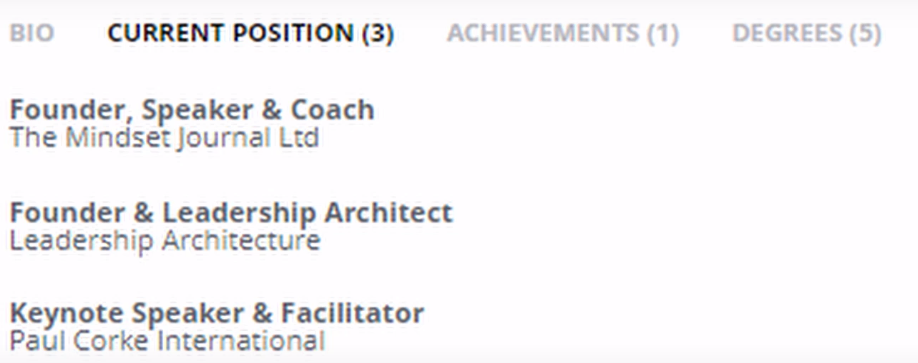
I understand that you want to put something very unique there, but I'm wondering what is a leadership architect? Is it a leadership expert? Is it a leadership strategic advisor? So that might need a little explanation of what that is.
And that should happen somewhere in the profile, whether that's in the subtitle or in a different place in the bio, that can definitely help.
And actually, he does come up towards the lower parts of the bio where he talks about leadership architecture, he said innovative leadership consultancy.
One word about consultancy.
Many of you are doing the speaking, training, consultancy. And I think these are slightly different drums, where if you give a keynote and you give a speech, it has to be extremely valuable, obviously.
But I think some organizers are wary, are a little cautious with consultants, because they might think, "Oh, will he upsell me? Will he try to provide broader consulting than speaking?"
So in terms of preempting, preventing, this concern, you just might want to say, "Well, my speech already is extremely valuable for the following reasons."
And then, if you want, "I am available for consulting," but not to have that doubt or that back thought where they say, "Okay, I'd rather not hire someone who is first and foremost a consultant, and they happen to be doing speaking as a secondary job."
So think with the organizer's head and try to find out what concerns they might have.
And then talking about this — what do organizers think — well organizers, they just want to minimize risk. That's the number one thing that they want to do. They want to minimize the risk that their boss, whoever that is, that could be the market, and that could be really the boss who's their superior, is not going to say, "Oh, this person didn't deliver a lot of value," or, "This person is very knowledgeable, but they're not a very good presenter."
They want to be sure. And how do you help them be sure? You think about the 5, 10, 15 things they might push back against you as a speaker, and address each of those points upfront, so they say,
"Well, you might be too expensive."
"Well, I'm not sure that you're a good presenter."
"Well, I'm not sure you would understand the unique situation of our company, or association, or chamber."
And you can say, "Well, I've worked with the following clients, and for each of them I customized, I tailored, my presentation."
Or, "I do that which is obviously included in my fee to make sure that you get a very unique presentation."
Let's go a little further with Paul's profile. If you scroll down a bit, you can see the titles. So again, "Reframe your mindset for 2020".
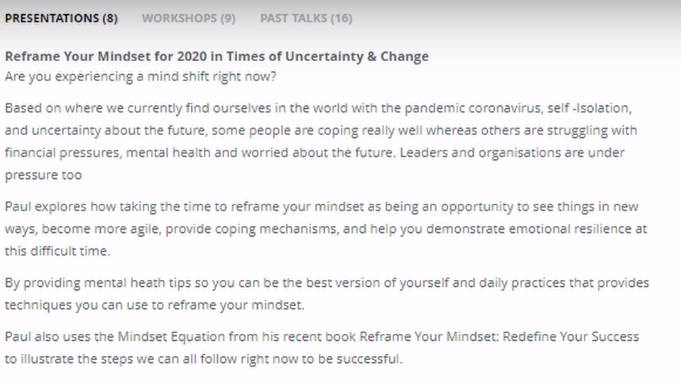
I think this is good because it's very topical, given that the very difficult situation many people are in around the world because of the Corona, the COVID-19.
And this is good in the sense that it's highly relevant. Now, reframe the mindset, it's a little bit broad for my taste.

So if I'm an event planner I'd say, "Okay, so how are you going to reframe the mindset of my team, or of the board, or the participants that I would collect as part of my event?"
And some of the messages there I see again, it's a little too broad. So, ‘become more agile’, ‘coping mechanisms’? Be more specific, "Here are the specific things I'm going to teach them that they can do," or, "I'm going to give them a 15-step process as part of my presentation that they can follow right off the bat."
Being concrete becomes really, really important in the presentation. It's not only just ‘motivate a team’, not only ‘demonstrate a certain point’, but you want to make clear what they are going to walk away with.
And you can put that into the presentation description upfront. So, "I'm going to talk about this and this, and your team will walk away with the following ideas as a result."
And similar too, if you scroll down. So, ‘resilience backpack’, yeah, this is sort of a problem description type that I mentioned earlier, and saying okay, so what comes then? What is the result of the talk?

Okay, let's see a couple of other things. So, books and articles: They are rather important, though many, many speakers have books, shorter or longer, sometimes self-published, sometimes not.
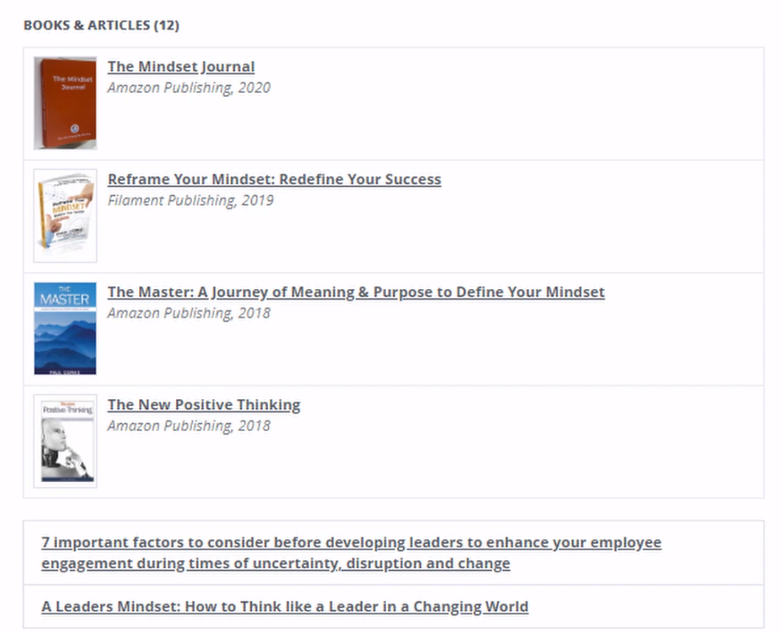
Books and articles are often, let's say, a sort of unspoken requirement for a speaker to establish their subject matter expertise, but that can be done in many other ways.
Articles certainly are less difficult than authoring a book, but many of these could be showcased through videos or, just simply, even photos showing that you have the speaker authority and the subject matter authority that organizers will be looking for.
Good. Now let's look at another one, and I think I may have seen them among the participants. So Gordana, Gordana Kadoic, if I'm pronouncing your name properly? I'll paste your speaker link into the chat box, you will have that right there.
And let me address here, there's one question that Peter mentions here, so "Sometimes, people try to oversell by using big words, when something simple will often work better."
I fully agree, Peter. I often see that big words backfire, and here are one or 2 ideas there:
If you self-describe, because obviously you self-describe in your speaker page, you want to put your best self forward, so while Gordana's page is loading, I'll tell you these ideas.
So you want to describe yourself in the best possible light.
And it is difficult because you want to really show that you're serious, you're an expert, you know your stuff, but if you do, if you overkill that, it really can backfire.
To say that you're an award-winning speaker, that's great, that's a description of the situation; but saying, "I'm an outstanding speaker"? Well, let others decide whether you're outstanding or not.
If I say, "I've won a regional speaking contest at Toastmasters," that's a pretty good way of showcasing that I'm probably a good speaker.
Or, "I've given 5 TED Talks," well that would show that you are a good speaker, or most probably you are a good speaker.
So be very careful with those adjectives and the way you self-describe.
This is not about Gordana, this is a broad general comment.
Watch very carefully the kind of words you use, because that can really backfire.
And another idea is, when you describe the talk, be very down to earth and say, "This talk has proven," or, "Previous clients," or, "10 previous clients who have hired me for this talk have benefited in the following way."
Then the event planner will say, "Okay, actually that makes sense" — as long as they believe your claim, and as long as it's really credible based on the other little cues that are shown on your speaker page, they are going to say, "That actually makes sense."
And then they draw the conclusion you want them to draw, which is when it might click and they say, "Okay, let me ask for an offer or let me hire this person."
Good. So looking at Gordana's page — hopefully, you could pull it up.
Popular Categories